What Is MMSBRE? Meaning, Streaming and Business Uses Explained
If you have come across the word mmsbre in a search result or a tech article, you probably did what most people do: you paused, read it again, and wondered whether you had missed a new technology. The word looks like an acronym, it sounds technical, and the pages that use it often explain it with confidence. Yet the honest starting point is simpler than that. MMSBRE has no single official definition, no standards body behind it, and no product you can buy under that name. It is an emerging term, and its meaning depends on the context where you find it.
That does not make the word useless. People use shorthand all the time to describe a complicated set of tools working together, and mmsbre is being used in exactly that way. In most of the recent articles about it, the letters stand for Multi-Media Streaming and Broadcast Relay Environment. In a smaller group of articles, the same letters are used for a business idea instead. This guide explains both readings, shows how the streaming version is supposed to work, and tells you how to judge the term when you meet it somewhere else. Nothing here is presented as an official standard, because none has been confirmed.
What MMSBRE Means in Plain Words
Take the most common expansion apart, piece by piece, and it starts to make sense. Multi-media means more than one kind of media at once: video, audio, captions, graphics, and the small pieces of data that travel with them. Streaming means sending that media over a network in a steady flow, so playback can start before the whole file has arrived. Broadcast relay means taking one source feed and forwarding it, often in adapted forms, to many destinations. Environment means the whole set of tools, servers, and controls working together, rather than one single device or program.
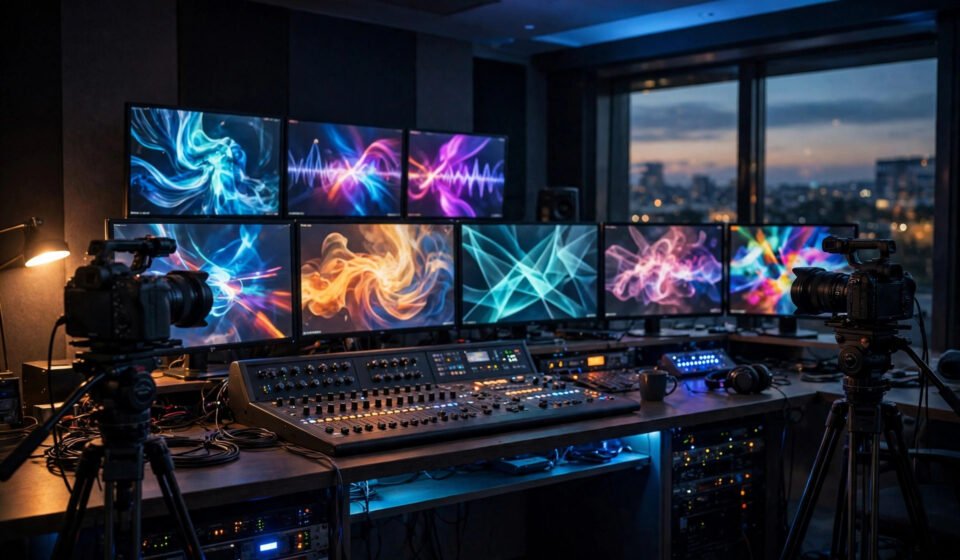
Put together, the phrase describes a connected setup that captures media, processes it, sends it onward to several places, delivers it to viewers, and keeps an eye on how well it is performing. A live football match sent to a website, a phone app, and a smart television at the same time is the kind of job this phrase is meant to describe. So is a company meeting streamed to staff in different offices, or a concert broadcast to ticket holders watching from home. The point of the label is not to name a new invention. It is to give people a short way of talking about the full path media takes, from the camera to the screen, as one system instead of a pile of separate parts.

MMSBRE at a Glance
| Item | What is known |
|---|---|
| Term | MMSBRE |
| Most common expansion | Multi-Media Streaming and Broadcast Relay Environment |
| Official standard | None confirmed; no standards body definition has been found |
| Type | A descriptive framework term, not a single product |
| Main idea | Capturing, processing, relaying, and delivering media as one connected environment |
| Other expansions online | Several, including business and workflow versions, none officially confirmed |
| When it appeared | Content about the term began accumulating in early 2026, according to search index data reported by other explainers |
| Best way to use it | Only with context; always check what the writer means by it |

How a Streaming Setup Like This Works
Most explanations of the streaming reading describe five stages, in the same order the media itself travels. The first stage is ingestion, where a camera, a microphone, a screen capture, or an existing feed enters the system. This is the raw material. It is heavy, uncompressed, and in no state to send to thousands of viewers at once, but it is the starting point for everything that follows.
The second stage is processing and encoding. Raw media is converted into several sizes and formats, so a viewer on a fast home connection can watch in high quality while a viewer on a weak mobile signal still gets a watchable picture. Captions can be added, sound levels can be balanced, and the stream can be cut into small chunks that a player can fetch one at a time. This stage is where most of the quiet technical decisions live: which formats to support, how many quality levels to offer, and how much delay is acceptable.
The third stage is the relay, the part the name highlights. A relay takes the processed feed and forwards it to its destinations. That might mean sending it to several platforms at once, to servers in different regions, or to a recording system for later viewing. A good relay also adapts. If one destination needs a different format, the relay supplies it. If one path fails, traffic can move to another. Without this stage, a broadcaster would have to send a separate feed to every viewer from a single source, which would fall over quickly under real demand.
The fourth stage is delivery. This is usually handled by a content delivery network, a spread-out set of servers that hold copies of the stream close to viewers. Instead of every viewer pulling from one central server, each viewer pulls from a nearby one. That keeps playback smoother and spreads the load. The player on the viewer’s device then puts the chunks back together, adjusts quality if the connection changes, and shows the picture and sound.
The fifth stage is monitoring. Someone, or something automated, watches for failures: a frozen picture, a gap in the sound, a server that has stopped responding, or a sudden drop in viewers. In a live event, a problem caught in seconds can be fixed before most viewers notice. A problem caught in minutes can mean an audience that has already left. Monitoring is not an extra. In a system where five stages have to work in sequence, it is the part that tells you which stage has broken.
The useful idea here is the joins between the parts. Encoding can be perfect and still useless if the relay fails. Delivery can be fast and still useless if the original capture was poor. Thinking of the whole chain as one environment, rather than five separate purchases, is the reason the term exists at all.

The Business Reading of MMSBRE
A second group of articles uses the same letters for something quite different. In that reading, MMSBRE stands for a business framework built around modern business efficiency, resource management, strategic planning, and customer experience. The idea is a loop rather than a list: a company improves how it works, uses its people and money more carefully, plans with a longer view, and pays closer attention to customers, then feeds what it learns back into the next round.
There is nothing unusual about the advice itself. Businesses have talked about efficiency, planning, and customer experience for decades, and the four parts of this framework are familiar ideas with new labels. What is unusual is the name. Like the streaming reading, this business reading has no confirmed origin in established business literature, no named author, and no organisation that owns or certifies it. It appears in online articles that present it as a practical framework, and readers should treat it as one writer’s way of organising familiar advice, not as a recognised method.

Streaming Meaning vs Business Meaning
| Aspect | Streaming and broadcast reading | Business and workflow reading |
|---|---|---|
| Full form used | Multi-Media Streaming and Broadcast Relay Environment | Modern Business Efficiency, Resource Management, Strategic Planning, and Customer Experience |
| What it describes | How media moves from capture to viewer | How a company organises its work and planning |
| Typical words nearby | Encoding, relay, delivery, viewers, latency | Efficiency, resources, planning, customers |
| Is it a product? | No | No |
| Official status | Emerging, not standardised | Emerging, not standardised |
| Useful as | A way to talk about a streaming chain as one system | A way to organise familiar business advice |
Where You Would Actually Meet These Ideas
In real life, you are far more likely to meet the pieces than the word. A school that streams its assemblies to parents is using capture, encoding, relay, and delivery, whether or not anyone in the building has heard of mmsbre. A small news outlet that posts the same live video to its website and two social platforms is doing multi-destination relay. A fitness instructor teaching a live class to people at home is relying on the same chain, and on monitoring to know when the picture has frozen.
The business ideas are just as ordinary. A shop owner who tracks which products sell, plans stock for the next month, and answers customer messages promptly is practising efficiency, planning, and customer care without needing a framework name for it. The framework adds a label and a loop: check what worked, adjust, and repeat. That is sensible advice, and it does not become more or less sensible because it has an acronym attached.
How to Judge the Term When You See It
Because the word has no settled meaning, the burden falls on the reader. A few simple checks will save you from confusion. First, look for a definition in the same article. A careful writer will say what they mean by the letters in the first few paragraphs. If they never do, treat the rest of the article with caution.
Second, look for specifics. A genuine technical claim names tools, formats, or numbers you can check: which encoder, which protocol, how much delay, how many viewers. A vague claim that only repeats the acronym and promises transformation is not giving you anything to verify. Third, look for a source. Is the writer pointing to documentation, a standards document, or a named product? Or is the only source another blog post that says the same thing? For mmsbre, the trail so far leads to other blog posts, not to a standards body or a vendor.
Finally, be wary of price and performance claims attached to the word. No verified price, owner, user count, or performance figure for MMSBRE itself has been published, because there is no single thing to measure. If a page quotes a price for MMSBRE, or claims a specific number of users, ask what exactly is being sold or counted. The honest answer will usually be a specific product or service with its own name, and the acronym will turn out to be decoration.
FAQs
What does mmsbre stand for?
The most common expansion in recent articles is Multi-Media Streaming and Broadcast Relay Environment. It is not an officially confirmed full form, and other expansions exist, so always check the context of the page where you found it.
Is mmsbre a product I can buy?
No. There is no verified product, platform, or software package called MMSBRE. The term describes a combination of familiar tools working together, such as cameras, encoders, servers, and players, rather than a single thing you can purchase.
Is mmsbre an official standard?
No official standard has been confirmed. No recognised standards organisation or major technology vendor has published a definition of MMSBRE, and the term does not appear in established technology documentation.
What is the business meaning of mmsbre?
Some articles use the letters for a business framework covering modern business efficiency, resource management, strategic planning, and customer experience. Like the streaming reading, it is an emerging online use with no confirmed origin, and it organises familiar business advice under a new label.
When did the term mmsbre start appearing?
According to search index data reported by other explainers, content about the term began accumulating in early 2026, when several blogs published definitions within weeks of each other. That timing is reported by those explainers, not by an official record.
Useful links: ClockToday | Google