
Portar Leisa Explained: What This Mysterious Phrase Really Means (and What It Doesn’t)
Let’s start with the honest version, because the honest version is the whole point of this one: portar leisa doesn’t have a single agreed meaning. Type it into a search engine and you’ll get confident-sounding answers — but they don’t agree with each other, and none of them comes from a source you’d call authoritative. No dictionary lists it. No university, no established tradition, no widely known book claims it. What you find instead is a handful of low-quality websites each offering a different explanation, as if the phrase means something settled. It doesn’t.
The short answer: nobody owns this phrase
Search for portar leisa and you’ll run into roughly three different claims. Some pages describe it as a structured process — a way of moving or adapting a system from one environment to another. Others describe it as a way of living: carrying life with ease, keeping things simple, letting go of burdens you don’t need. And a few describe it as some kind of digital design or content framework.
Those three ideas barely overlap. When a phrase means three different things on three different pages, it doesn’t really have a definition yet — it has a fan club of guesses. It’s not a term with a history you can trace. It’s a phrase floating around the internet, picking up meanings as it goes. Anyone who presents one of these definitions as the real one is either guessing or selling something.
What the words themselves suggest
Even without a settled definition, the two halves of the phrase do tell us something.
Portar: to carry
“Portar” comes from the Latin portare, which means “to carry.” That root is still alive and well — you can hear it in Portuguese, Spanish and Italian, where portar is an everyday verb meaning to carry or to bear something. English kept a version of it too: “portable,” “transport,” “import,” “support.” Every one of those words has carrying at its heart.
So the first half of the phrase is solid ground. Whatever portar leisa means, carrying is part of it. The question is what, exactly, is being carried — and how.
Leisa: the softer half
“Leisa” is where things get fuzzier. The sources that talk about it tend to link it to the German word leise, which means “quietly” or “gently.” Others connect it to ideas of legacy or light. None of this is settled etymology — these are suggestions from the same online pages that can’t agree on what the whole phrase means, so take them as suggestions, not facts.
Still, the pattern is worth noticing. Nearly every reading of “leisa” points in the same direction: softness, quiet, lightness. Put the two halves together and you get something like “carry gently” or “carry lightly” — probably why the phrase keeps showing up. It sounds like a promise: that the things you carry don’t have to weigh you down.

How portar leisa shows up online
Since there’s no official definition, the next best thing is to look at how people actually use the phrase. The uses fall into a few loose camps. None of them is wrong, exactly — but none of them is the answer either.
The lifestyle reading: carry less, live lighter
This is the most common way you’ll see portar leisa used, and honestly, it’s the most appealing one. In this version, the phrase is a kind of personal philosophy: don’t drag around more than you need. That goes for stuff — the overstuffed bag, the cluttered room, the calendar packed with things you said yes to without thinking. But it also goes for the invisible things: old grudges, other people’s expectations, the habit of saying yes when you mean no.
The idea is simple enough to fit on a sticky note: carry only what matters, and carry it gently. It’s the same instinct behind minimalism and slow living, just dressed up in a prettier phrase. If you’ve ever cleaned out a closet and felt ten pounds lighter, you already know what this version of portar leisa is getting at.
But here’s the catch: this isn’t an ancient tradition. Nobody handed this idea down through the generations under this name. It’s a modern phrase attached to a timeless instinct. The instinct is real. The label is new. There’s nothing wrong with that, as long as we’re honest about it.
The tech and design reading: a framework by any other name
Then there are the pages that treat portar leisa as a framework — a way of structuring digital design or content, or of moving a system from one place to another. The language here tends to be vague in a very particular way: lots of words like “structured process” and “adaptation,” not many concrete examples of anyone actually using it.
That’s usually a tell. Real frameworks have documentation, case studies, people arguing about them on forums. Portar leisa has none of that — just a handful of pages describing it in general terms, which is what you get when a phrase is invented for search traffic rather than for actual use.
| How it’s described online | What it claims to be | What’s actually verifiable |
|---|---|---|
| Lifestyle philosophy | “Carrying life with ease” — balance, simplicity, letting go | A real human instinct; the label itself is new and unattributed |
| Systems process | Transferring or adapting a system between environments | No documented method, no case studies, no practitioners |
| Design/content framework | A structured way of organizing digital design or content | No documentation or community using it under this name |

Why there’s no settled definition
It helps to understand how phrases like this end up on the internet. The web rewards new content, and new content needs topics. A phrase that sounds meaningful but isn’t defined yet is perfect raw material: anyone can write an article “explaining” it, because there’s no expert to contradict them. Each new page adds another definition, and the definitions pile up until the phrase looks established — even though nobody ever established it.
That’s almost certainly what happened with portar leisa. The phrase has the shape of something old and wise — Latin root, soft second word, the feel of a proverb. It sounds like it should mean something, so people filled in the blank, each in their own way, and now the blank is full of different answers.

If you like the idea anyway, here’s the useful part
None of this means you should throw the phrase away. The question isn’t whether portar leisa is a real tradition — it isn’t, as far as anyone can show. The question is whether the idea behind it is useful to you. And for a lot of people, it is.
Most of us carry too much. Not just in our bags — though the bag is a good place to start — but in our schedules, our inboxes, our heads. We keep things because getting rid of them feels like a decision, and decisions are tiring. So we carry them instead, and the carrying gets tiring too, only slower and quieter.
The useful core of portar leisa is a small daily practice: look at what you’re carrying, and ask whether it still needs to come along. That applies to the bag you pack and the desk you work at — and to the less obvious things, like the commitment you agreed to months ago and now dread.
You don’t need a philosophy with a Latin name to do this. But if the phrase helps you remember to do it, then it has done its job. “Carry only what matters, set it down gently” — that’s the whole thing. Everything else is decoration.
A few small ways people put this into practice:
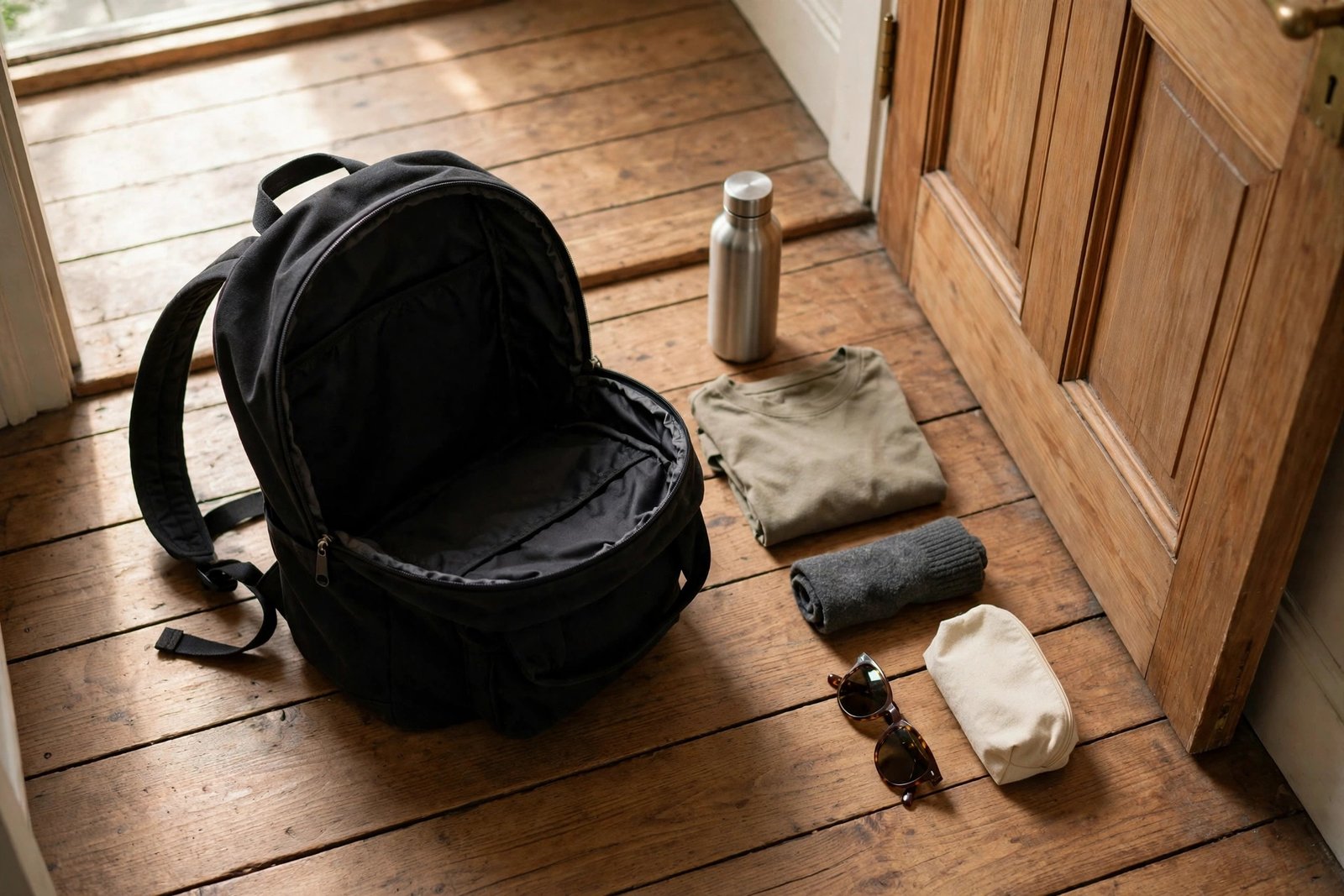
- The bag test. Once a week, empty your bag completely. Put back only what you actually used in the last seven days. The rest stays home for a week. Most of it won’t be missed.
- One in, one out. Every time something new comes into your life — a purchase, a commitment, a project — something old goes out. It keeps the load from growing without you noticing.
- The gentle set-down. When you finish something — a task, a conversation, a hard day — give yourself a minute before picking up the next thing. Setting things down gently changes how the whole day feels.
- The honest no. The lightest thing you can carry is a schedule with room in it. Saying no to one thing you don’t want is worth more than organizing ten things you do.
So what is portar leisa, really?
It’s a phrase without a settled meaning, made of real words, that people are using to describe the feeling of carrying less and living lighter. The word parts check out — “portar” really does come from Latin portare, to carry — and the softer reading of “leisa” fits the mood, even if it isn’t proven. The lifestyle reading is the one with the most life in it; the tech and framework readings look, on the evidence available, like labels in search of a thing to label.
That’s not a satisfying answer if you wanted a definition you could quote. But it’s an honest one. Left open, the phrase can be whatever helps you: a reminder to pack lighter, a reason to clear the desk, a permission slip to put something down.
So take the useful core and leave the rest. Carry only what matters. Set it down gently. That’s portar leisa, as far as anyone can honestly say.
FAQs
What does portar leisa mean?
There is no single agreed meaning. Online sources give conflicting explanations — a lifestyle idea about carrying life with ease, a process for moving a system between environments, and a digital design framework. None comes from an authoritative source, so the phrase is best understood as an undefined term with several loose online uses.
Where does the phrase portar leisa come from?
We don’t actually know. “Portar” comes from the Latin portare, meaning “to carry,” and survives as a verb in Portuguese, Spanish and Italian. “Leisa” is often linked by online sources to the German word leise (“quietly, gently”) or to ideas of legacy and light, but that connection isn’t settled. There is no documented origin story behind the full phrase.
Is portar leisa an ancient philosophy or tradition?
No — there is no evidence for that. Nothing links portar leisa to any ancient tradition, historical text, or established school of thought. The idea it points to — living simply and carrying less — is genuinely old and appears in many cultures, but the phrase itself looks modern, and the claims about its history come from low-quality websites, not verifiable sources.
How is portar leisa used as a lifestyle idea?
In its most common online use, portar leisa means carrying only what matters and letting go of the rest — fewer possessions, fewer pointless commitments, less mental clutter. The practical core is simple: look at what you’re carrying, keep what serves you, and set the rest down gently. It overlaps with minimalism and slow living, just under a different name.
Should I use portar leisa as a framework for my work or design?
You can use the phrase as a personal label for your own method, but there’s no established portar leisa framework to follow — no documentation, no community, no case studies under that name. If the words help you think clearly about your work, use them; just don’t present them as a recognized industry standard, because they aren’t one.
Useful links: ClockToday | Wikipedia | Google | MSN